build business credit tradelines | Last Updated: June 2026 | Author: CPN Tradelines Team | Reading Time: 8 min
How to build business credit with tradelines is a question we hear from profitable, established business owners more often than you’d expect — because revenue alone doesn’t mean anything to a lender if your company looks like a blank slate on paper. Without tradelines, your business is financially invisible. Lenders can’t measure risk, vendors hesitate to extend terms, and even a company doing real numbers gets treated like a startup with no track record. Here’s how to fix that.
What You Will Learn in This Guide
- What actually counts as a business tradeline
- Why a blank business credit file hurts you even with strong revenue
- The account types that build the strongest business credit profile
- A step-by-step path for building business credit with tradelines from zero
- Frequently asked questions about the process
Build Business Credit Tradelines — Start Here
Business tradelines are the credit accounts that show up on your company’s business credit report — business credit cards, vendor accounts, equipment leases, loans. Lenders, suppliers, and credit bureaus use them to measure whether your business handles its financial obligations responsibly.
Here’s what catches a lot of owners off guard. None of this overlaps with your personal credit. Your business credit file is tracked completely separately, through different bureaus, using different scoring models. A spotless personal score does not automatically translate into a strong business profile.
Without tradelines, your company is what’s known in the industry as a “blank file.” Lenders have no data to measure risk against, which usually means automatic denials or, if you do get approved, painfully high interest rates. Vendors may also hesitate to extend net-30 or net-60 terms without proof you pay reliably.
Build Business Credit Tradelines With the Right Account Types
A strong business credit profile isn’t built on one account type — it’s built on diversity. Here’s what actually contributes:
Business credit cards. These demonstrate responsible use of revolving credit and are usually the most accessible starting point for newer businesses.
Vendor accounts. Also called trade credit, these come from suppliers who extend payment terms — a net-30 account, for example, gives you 30 days to pay an invoice. Pay consistently and it becomes a tradeline that builds your file.
Equipment leases and loans. These show lenders you can manage structured, fixed-payment debt over time, which carries real weight for larger financing decisions down the road.
Lines of credit. A revolving business line of credit demonstrates ongoing, responsible credit management rather than a single transaction.
The companies that get approved for the best terms almost always have a genuine mix — not just vendor accounts, not just one credit card, but a real combination that shows lenders your business can handle different kinds of financial obligations.
The Main Business Credit Bureaus You Need to Know
Your personal credit runs through Experian, Equifax, and TransUnion. Business credit runs through a completely different set of players, and knowing how each one operates changes how you build business credit tradelines strategically.
Dun & Bradstreet (D&B). The most business-focused of the major bureaus — D&B doesn’t track personal credit at all. It assigns your business a DUNS Number, a unique nine-digit identifier, and is where the Paydex Score lives. D&B leans heavily on vendor and trade account reporting, so vendor tradelines carry real weight here.
Experian Business. The busines division at Experian is completely separate from its consumer credit division — your personal Experian file and your business Experian file share no overlap. Experian tracks both financial and vendor tradelines and produces the Intelliscore Plus rating.
Equifax Business. Equifaxhttps://www.dnb.com/en-us/ also maintains a business-specific credit file, often used by lenders alongside D&B and Experian Business data, particularly for larger commercial financing decisions.
FICO SBSS (Small Business Scoring Service). This isn’t a bureau exactly — it’s a scoring model that pulls data from multiple sources, including your business credit file and sometimes your personal credit, to generate a single score most SBA lenders use for loan eligibility screening.
Here’s the part that trips people up: a business can look completely different depending on which bureau a lender checks. Strong vendor relationships might show up clearly at D&B but barely register at Experian Business if those same vendors don’t report there. Building business credit tradelines that report broadly, not just to one bureau, gives you the most consistent profile no matter which lender or bureau gets pulled.
Blank File vs. File With Tradelines — The Real Difference
This comparison is the clearest way to understand why this matters so much:
| Situation | Blank File | File With Tradelines |
|---|---|---|
| How lenders see you | Financially invisible — no way to measure risk | Demonstrated experience handling credit |
| Loan approval odds | Extremely low, or only at very high interest rates | Significantly higher, with access to better terms |
| Vendor terms | Vendors hesitate to extend net-30/net-60 without history | Easier to secure favorable payment terms |
| Credit limits available | Minimal or none | Higher limits as account diversity and age grow |
This gap is often the literal difference between getting approved for the business line of credit you need to grow and getting turned down despite solid revenue numbers.
Build Business Credit Tradelines — What Scoring Models Reward
This isn’t just our take on it — it’s how the actual scoring systems are built:
| Scoring Model | Score Range | What It Rewards |
|---|---|---|
| D&B Paydex Score | 1 to 100 | Consistent on-time or early payment across reported trade accounts |
| Experian Intelliscore Plus | 1 to 100 | Account diversity across both financial and vendor tradelines |
| FICO SBSS Score | 0 to 300 | Used by most SBA lenders as part of loan eligibility screening |
The pattern across every model is the same — consistency and diversity matter more than any single account. A business with one strong vendor relationship will always score lower than one with a genuine mix reporting positive history over time.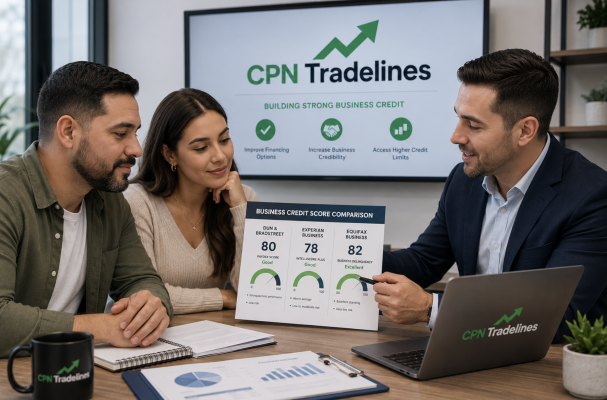
Build Business Credit Tradelines — Step by Step
If you’re starting from a blank file, here’s the realistic order of operations:
Step one — secure your foundation. Make sure your business has a proper EIN, a dedicated business bank account, and is registered correctly. Lenders and bureaus need to be able to verify your business is a legitimate, distinct entity.
Step two — open vendor accounts first. Net-30 vendor accounts tend to be the easiest entry point since many suppliers extend trade credit without requiring an established credit history.
Step three — add a business credit card. Once you have one or two vendor accounts reporting, a business credit card adds the financial tradeline diversity that lenders specifically look for.
Step four — let it season. Building a file that actually moves the needle for larger financing typically takes 12 months or more of consistent, on-time reporting. There’s no real shortcut around the time component.
Step five — pair it with strong personal credit. Especially for newer businesses, lenders often look at your personal credit alongside your business file. Authorized user tradelines on your personal profile can support a business loan application while your business credit is still developing.
Common Mistakes That Slow Down Approval
We see business owners run into the same walls again and again:
Assuming strong revenue replaces the need for tradelines. It doesn’t. Lenders want proof of how you handle credit, not just proof you make money.
Building only vendor accounts. A file with vendor tradelines and nothing else often looks incomplete to lenders evaluating larger financing.
Trying to buy a primary tradeline outright. Unlike personal tradelines, primary business credit must be built — not purchased. A reputable service can guide your strategy, but they can’t sell you ownership of an account.
Giving up before the file seasons. Twelve months feels long when you need funding now, but rushing the process tends to produce a thinner file with worse terms, not faster approval.
Frequently Asked Questions
How long does it take to build business credit tradelines?
Initial accounts typically begin reporting within 60 to 90 days. Building a file strong enough for significant financing — SBA loans, larger lines of credit — usually takes 12 months or more of consistent positive reporting across a diverse mix of accounts.
Can I buy business tradelines the way people buy personal ones?
No, not in the same sense. Primary business tradelines must be built through legitimate, actively reporting accounts — the business has to be the real account owner. A structured service can guide and accelerate the process, but ownership itself can’t be purchased or transferred.
Does my personal credit matter if I’m building business credit?
Yes, particularly for newer businesses. Lenders evaluating SBA loans and other financing frequently review personal credit alongside the business file until the business has enough independent history of its own.
What’s the fastest way to get my first business tradeline?
Vendor accounts, typically. Many suppliers extend net-30 trade credit to new businesses without requiring established credit first, making them the most accessible entry point.
Do all bureaus track business tradelines the same way?
No. Some specialize more in financial tradelines, others in vendor tradelines, and your file can look stronger or weaker depending on which bureau a lender actually checks. This is part of why building diversity across account types matters.
How many tradelines does my business actually need?
There’s no fixed magic number, but a mix of at least one vendor account, one business credit card, and ideally an installment account like an equipment lease tends to demonstrate the diversity scoring models reward most.
The Bottom Line on How to Build Business Credit Tradelines
How to build business credit with tradelines really comes down to two things — diversity and patience. A blank file is invisible to lenders no matter how strong your revenue is. A file built on a genuine mix of vendor and financial accounts, given enough time to season, is what actually unlocks better loan terms, higher limits, and real lender trust.
We’ve guided business owners through this exact process for years, and the ones who get the best results are almost always the ones who start early and stay consistent rather than waiting until they’re in a financing crunch.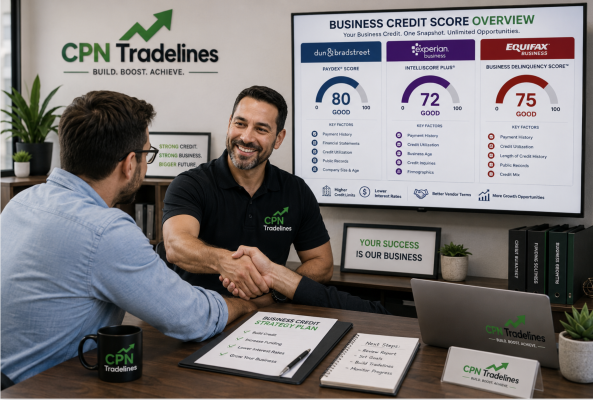
Ready to Build Your Business Credit Strategy?
Our specialists will look at where your business credit file actually stands and put together a clear plan to build the diversity and history lenders want to see.
Request Your Free Consultation — cpntradelines.com/contact-us/
No cost. No hard credit pull. Just a straight answer about where you stand and what comes next.
About CPN Tradelines
CPN Tradelines has specialized in credit profile strategy since 2006, working with individuals and business owners across all 50 states. We help build real, lasting credit — personal and business — using legal, transparent methods, and we tell you exactly what your situation actually needs.